Listen up, kitchen operatives. If you have ever felt like you were chewing on a handful of pine needles and damp cardboard, you have fallen victim to a failure in structural engineering. Most people approach raw brassica with the optimism of a novice architect and the results are predictably disastrous. We are here to talk about the aggressive, necessary, and scientifically sound process of Kale Salad Softening. This is not a gentle toss; it is a mechanical breakdown of cellulose and lignin. Raw kale is a fortress of fibrous plant walls that the human digestive tract is ill-equipped to breach without tactical intervention. To transform these bitter, rigid leaves into a silky, piquant masterpiece, you must engage in a deliberate act of culinary demolition. We are going to use salt as an abrasive, acid as a solvent, and manual labor as the kinetic energy required to rupture those stubborn cell walls. By the time we are finished, your greens will be viscous, tender, and ready to infuse with flavor rather than merely repelling it.
THE DATA MATRIX
| Metric | Specification |
|---|---|
| Prep Time | 15 Minutes |
| Execution Time | 10 Minutes |
| Yield | 4 Servings |
| Complexity (1-10) | 3 |
| Estimated Cost per Serving | $2.15 |
THE GATHERS
Ingredient Protocol:
- 350g / 2 large bunches Lacinato (Dino) Kale
- 60ml / 0.25 cup Extra Virgin Olive Oil
- 30ml / 2 tbsp Fresh Lemon Juice
- 5g / 1 tsp Flaky Sea Salt
- 15g / 1 tbsp Dijon Mustard
- 45g / 0.3 cup Toasted Pine Nuts
- 50g / 0.5 cup Shaved Parmigiano-Reggiano
- 2g / 0.5 tsp Freshly Cracked Black Pepper
Section A: Ingredient Quality Audit:
The most common failure point starts at the procurement phase. If your kale feels limp or displays yellowing edges, the cellular turgor pressure is already compromised. This leads to mush rather than a refined silkiness. If you find yourself with slightly wilted greens, submerge them in an ice-water bath for twenty minutes to re-hydrate the cells before you begin the Kale Salad Softening process. Furthermore, do not settle for pre-shredded bagged kale. Those cuts are often irregular and include the woody ribs which are nearly impossible to soften mechanically. Always buy whole bunches and perform the de-stemming yourself using a sharp chef knife or a bench scraper to clear the deck.
THE MASTERCLASS
1. The De-Stemming Maneuver
Strip the leaves away from the central rib. The rib is pure lignin and has no place in a high-performance salad. Use a digital scale to ensure you have exactly 350 grams of usable leaf matter. This precision ensures your dressing-to-fiber ratio remains optimal.
Pro Tip: Use your bench scraper to quickly gather the discarded stems. These can be saved and sliced paper-thin for a stir-fry, but for our purposes, they are structural waste.
2. The Chiffonade Calibration
Stack the leaves, roll them tightly like a cigar, and slice them into thin ribbons. Smaller surface areas allow the salt and acid to penetrate the fiber matrix more efficiently.
Pro Tip: A sharp blade is non-negotiable. A dull knife will crush the cells rather than slicing them; this leads to premature oxidation and a metallic aftertaste.
3. The Kinetic Massage
Place the kale in a large stainless steel bowl. Add the sea salt and half of the lemon juice. Reach in with both hands and squeeze the kale aggressively for three to five minutes. You are looking for the volume to reduce by nearly half and the color to shift to a deep, translucent emerald.
Pro Tip: This is the core of Kale Salad Softening. The salt acts as a microscopic abrasive while your manual labor breaks down the cellulose. You are essentially pre-digesting the plant.
4. The Emulsion Integration
In a small saucier or glass bowl, whisk the remaining lemon juice, mustard, and olive oil until the mixture is fully viscous and stable. Pour this over the softened greens and toss to coat every fiber.
Pro Tip: The mustard acts as a natural emulsifier; it bridges the gap between the aqueous lemon juice and the lipid-heavy oil, ensuring the dressing clings to the kale instead of pooling at the bottom.
5. The Final Texture Layering
Fold in the shaved cheese and toasted pine nuts. The cheese adds a savory depth while the nuts provide a necessary crunch to contrast the now-tender greens. Use a digital scale for the cheese to maintain caloric accuracy.
Pro Tip: To render the best flavor from your pine nuts, toast them in a dry pan until they are golden brown. This releases essential oils that provide a toasted, nutty aroma.
Section B: Prep & Timing Fault-Lines:
The biggest mistake in timing is serving the salad immediately after the massage. While the mechanical breakdown is instant, the flavor infusion takes time. Allow the salad to rest for at least fifteen minutes at room temperature. However, do not let it sit for more than four hours before serving, or the acid will begin to turn the vibrant green into a dull, unappetizing olive drab. If your kitchen is over 75 degrees Fahrenheit, move the bowl to the refrigerator to maintain structural integrity.
THE VISUAL SPECTRUM
Section C: Thermal & Visual Troubleshooting:
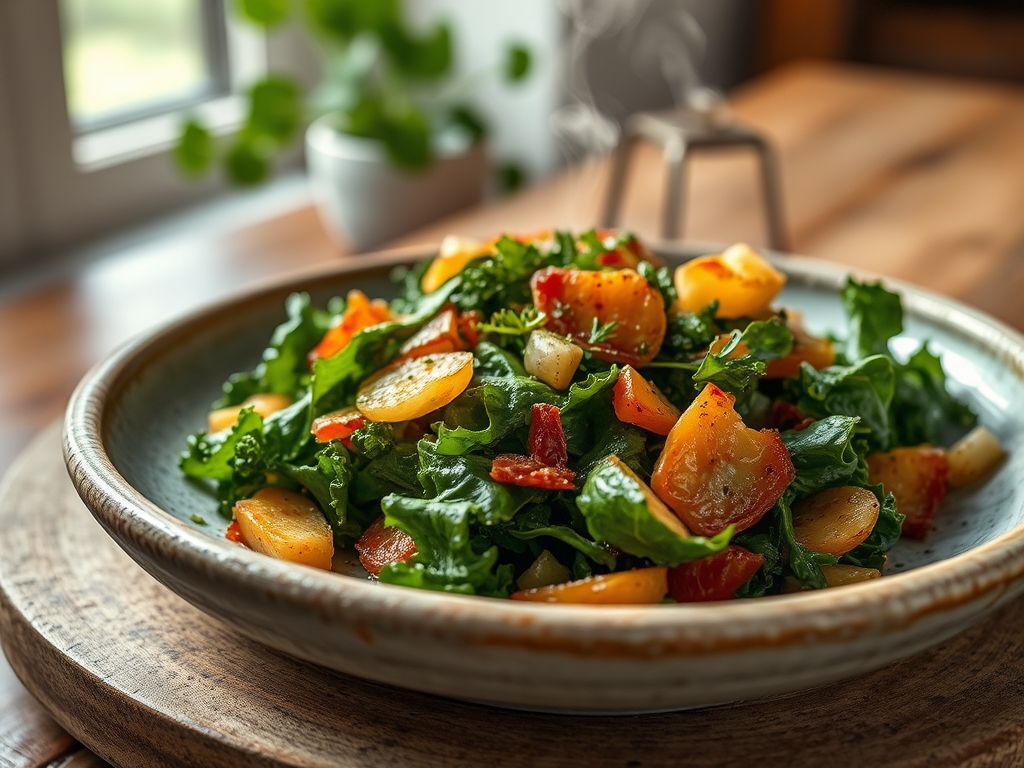
Referencing the Masterclass photo, notice the deep saturation of the leaves. If your salad looks dusty or light green, you have not massaged it long enough. The leaves should look wet but not drowned. If you see a pool of liquid at the bottom of the bowl, your salt ratio was too high, drawing out excessive moisture. To fix a "dull" looking salad, add a final micro-spritz of lemon juice right before serving to aerate the aroma and brighten the visual green spectrum. If the cheese looks clumpy, it was likely shaved too thick; use a vegetable peeler for translucent, wide ribbons that drape over the greens.
THE DEEP DIVE
Macro Nutrition Profile:
A single serving of this audited kale salad provides approximately 210 calories. You are looking at 18g of healthy fats, 8g of carbohydrates (4g of which are fiber), and 6g of protein. It is a nutrient-dense powerhouse with high concentrations of Vitamins A, K, and C.
Dietary Swaps:
- Vegan: Replace the Parmigiano-Reggiano with nutritional yeast or a salty, fermented nut cheese.
- Keto: This recipe is inherently keto-friendly. Increase the pine nuts or add avocado for additional healthy fats.
- GF: Naturally gluten-free. Ensure your Dijon mustard does not contain thickeners derived from wheat.
Meal Prep & Reheating Science:
Unlike delicate lettuces, massaged kale is a structural tank. It will not wilt into a soggy mess overnight. In fact, it often tastes better on day two as the flavors continue to infuse. Do not reheat this dish; the heat will collapse the remaining cellular structure and turn the oils rancid. Store in an airtight glass container to prevent the absorption of refrigerator odors.
THE KITCHEN TABLE
Why is my kale still tough after massaging?
You likely skipped the salt or didn't apply enough physical pressure. The salt is the abrasive agent that ruptures the cell walls. Increase your grip strength and continue until the volume drops significantly.
Can I use curly kale instead of Lacinato?
Yes, but curly kale has a more aggressive texture and more surface area. You will need to increase the massage time by roughly two minutes to achieve the same level of Kale Salad Softening.
Why does my dressing separate?
This is a failure of emulsification. Ensure you whisk the mustard and lemon juice together before slowly drizzling in the oil. This creates a stable matrix that won't break on the leaf.
How do I stop the kale from being too salty?
The salt is necessary for the mechanical breakdown. If the end result is too salty, increase the acid (lemon juice) or add a pinch of sugar to balance the palate without compromising the structural work.