Listen to the sound of a kitchen that has achieved total Chicken Stock Security. It is not the sound of a frantic boil; it is the rhythmic, tectonic thrum of a single bubble breaking the surface every three seconds. We are not merely boiling water with bird parts. We are conducting a high-stakes mineral extraction protocol designed to strip every milligram of collagen and marrow from the skeletal remains of the Gallus gallus domesticus. This is the bedrock of your culinary empire. Without a viscous, amber-hued foundation, your sauces will lack structural integrity and your risottos will fail to reach their potential. Achieving Chicken Stock Security means your freezer is armored with gold. It means you have successfully converted waste into liquid currency through the aggressive application of thermal energy and patience. We are looking for a final product so dense with gelatin that it shakes like a bowl of jelly when chilled. Forget the thin, saline-heavy liquids found in cardboard boxes. We are here to build a masterpiece of connective tissue degradation.
THE DATA MATRIX
| Metric | Specification |
|---|---|
| Prep Time | 30 Minutes |
| Execution Time | 6 to 12 Hours |
| Yield | 4 Liters / 1.05 Gallons |
| Complexity (1-10) | 4 |
| Estimated Cost per Serving | $0.15 |
THE GATHERS
Ingredient Protocol:
- Animal Chassis: 2.5kg / 5.5 lbs Chicken carcasses and necks.
- Aromatic Base: 500g / 1.1 lbs Yellow onions (halved, skin on for color).
- Structural Support: 250g / 8.8 oz Carrots (roughly chopped).
- Fiber Component: 250g / 8.8 oz Celery stalks (including leaves).
- The Trinity: 4 cloves Garlic (smashed); 10 Black peppercorns; 2 Bay leaves.
- Solvent: 6 Liters / 6.3 Quarts Filtered water.
Section B: Ingredient Quality Audit:
If your raw materials are subpar, the protocol will fail. Frozen bones often harbor "freezer burn" which introduces oxidized lipids into your stock. To fix this, blanch the bones in boiling water for five minutes and discard the gray foam before starting your main simmer. If your vegetables are limp, they have lost their cellular turgor. This is acceptable for stock, but ensure there is no mold; a single speck of blue mold will survive the boil and impart a musty, damp-basement flavor to the entire batch. If you lack enough bones, supplement with chicken feet. The high skin-to-bone ratio in feet provides a massive boost to the gelatinous viscosity of the final extraction.
THE MASTERCLASS
1. Thermal Pre-Treatment: The Roast
Preheat your oven to 220C / 425F. Arrange the chicken carcasses on a heavy-duty sheet pan. Roast until they achieve a deep, mahogany hue. This is the Maillard reaction in its most potent form. Use a bench scraper to remove any stuck bits from the pan; these are concentrated flavor crystals.
Pro Tip: Roasting the bones creates melanoidins, which provide the deep brown color and savory complexity. A digital scale ensures you have the correct ratio of bones to water, which is critical for achieving a set gel.
2. The Deglaze Maneuver
Transfer the roasted bones to a large stockpot or a professional-grade saucier. Place the roasting pan over a burner and add 250ml / 1 cup of water. Use your bench scraper to deglaze the pan, lifting every molecule of fond into the liquid. Pour this nectar into the pot.
Pro Tip: Deglazing captures the caramelized proteins that would otherwise be lost to the dishwasher. This step is the difference between a pale liquid and a rich, professional-grade stock.
3. Submersion and Initial Ignition
Cover the bones and aromatics with cold, filtered water. Bring the temperature up slowly. Never start with hot water; cold water allows the proteins to dissolve and rise to the surface slowly, keeping the stock clear.
Pro Tip: Using a digital thermometer, aim for a temperature of 90C / 195F. This is the "sweet spot" where collagen converts to gelatin without the turbulent movement that emulsifies fat into the liquid.
4. The Depuration Phase
As the pot approaches a simmer, a gray-white foam will rise. This is the scum. Use a fine-mesh skimmer or a large spoon to remove it aggressively. This is the primary requirement for Chicken Stock Security. If you stir this back in, your stock will be cloudy and bitter.
Pro Tip: The foam consists of denatured proteins. Removing them ensures a clean, piquant finish that does not taste of "dirty" poultry.
5. The Long Extraction
Simmer for a minimum of 6 hours. Do not cover the pot completely; allow a small amount of evaporation to concentrate the flavors. The liquid should reduce by approximately one-third.
Pro Tip: A saucier with its flared sides is excellent for reduction, but for high-volume extraction, a tall stockpot minimizes surface area and prevents the stock from reducing too quickly before the minerals are fully pulled from the bone.
6. The Filtration Protocol
Once the bones are brittle and have surrendered their essence, strain the liquid through a chinois or a fine-mesh sieve lined with cheesecloth. Do not press on the solids. Let gravity do the work to maintain clarity.
Pro Tip: Pressing on the vegetables will release starches and fibers that turn the stock murky. Patience is the ultimate tool in the infrastructure of flavor.
Section B: Prep & Timing Fault-Lines:
The most common failure in Chicken Stock Security is the "Hard Boil." If the heat is too high, the fat will emulsify into the water, creating a greasy, opaque liquid that cannot be clarified. If you notice a rolling boil, immediately drop the heat and add a cup of ice to shock the temperature back down. Another fault-line is the "Short Simmer." If you stop at two hours, you have flavored water. You have not achieved mineral extraction. The bones must be soft enough to crush between your fingers.
THE VISUAL SPECTRUM
Section C: Thermal & Visual Troubleshooting:
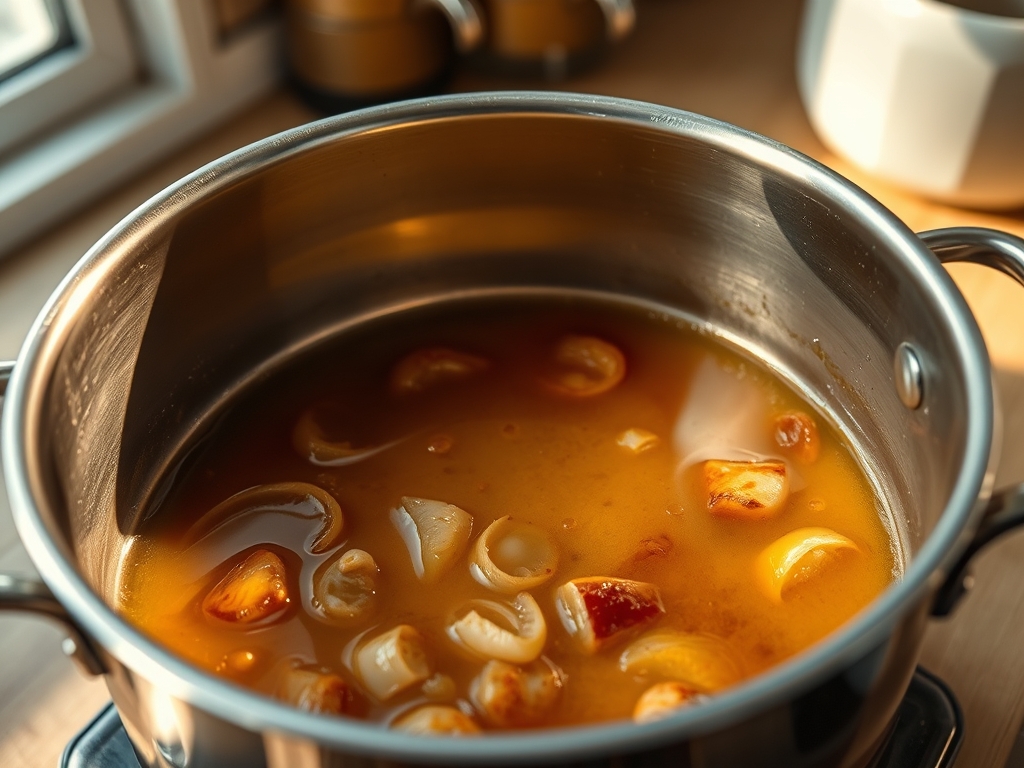
Referencing the Masterclass photo, your stock should exhibit a clear, translucent amber glow. If your stock looks like muddy dishwater, you likely skipped the depuration phase or boiled it too hard. If the color is too pale, your roast was insufficient; next time, leave the bones in the oven until they are nearly the color of dark chocolate. If you see fat globules floating on top, do not panic. Once the stock is chilled, the fat will solidify into a "fat plug" on the surface. This can be easily removed with a bench scraper, leaving you with the pure, fat-free gold beneath.
THE DEEP DIVE
Macro Nutrition Profile:
A standard 250ml serving of this high-density stock contains approximately 40 calories, 6g of protein (primarily collagen-based), 0g of carbohydrates, and 1g of fat (if properly skimmed). It is a micronutrient powerhouse, rich in glycine and proline.
Dietary Swaps:
For a Keto version, leave the fat plug intact for higher caloric density. For a Vegan alternative, replace chicken with 1kg of dried shiitake mushrooms and roasted kombu to mimic the umami depth. This recipe is naturally Gluten-Free.
Meal Prep & Reheating Science:
To maintain the molecular structure, cool the stock rapidly in an ice bath before refrigerating. This prevents the growth of thermophilic bacteria. When reheating, do so over medium heat. Do not microwave on high power, as uneven heating can break the delicate gelatin bonds and result in a thinner mouthfeel.
THE KITCHEN TABLE
Why is my stock a jelly when cold?
This is the ultimate sign of success. It means you have successfully extracted enough gelatin from the bones to create a semi-solid matrix. It will liquefy instantly when heated, providing a luxurious, viscous mouthfeel.
Can I use a pressure cooker?
Yes, for rapid deployment. A pressure cooker achieves extraction in 60 minutes. However, the lack of evaporation means the flavor will be less concentrated than the traditional open-pot method. You may need to reduce it afterward.
Should I add salt now?
Negative. Never salt your stock during the extraction phase. As the liquid reduces, the salt concentration increases. Always season the final dish that the stock is used in to maintain total control over the salinity levels.
How long does it last?
In the refrigerator, five days. In the freezer, six months. For maximum Chicken Stock Security, freeze the stock in ice cube trays. This allows you to deploy small, concentrated bursts of umami into any pan sauce at a moment's notice.